A signal in the digital dark: Why I founded Dogstar Press
The digital age has been a difficult ride for us romantic souls.
In the early years of cell phones and social media, I genuinely believed they were portals, crackling with possibility.
New channels through which hearts could more readily reach across the void to find each other and draw nearer. There was an innocence to all of it back then—the essay-length emails we earnestly sent each other, the thrill of the digital screech before the computer optimistically declared: “You’ve got mail!” Snapping and sharing a random scene or object through a grainy smartphone image. “It’s like a scrapbook, but online!” The first wave of friends many of us made on social platforms felt like pen pals with overlapping tastes and interests. (I still remember my small, special circle on Instagram circa 2009 with great fondness.)
Absorbed by the black rectangle
It is impossible to know the exact moment everything began to change—when the bloom tumbled off the rose—but it had something to do with money. Social media became monetized in new ways, and so the algorithm entered our lives. Silently it began to whir, holding us closer and closer in its steely arms, locking us into a limited view of the world and titling our perspective.
Meanwhile, the hardware that used to delight us—early iPods and BlackBerry models—became strictly utilitarian. Requirements to function smoothly in society. Things really fell off a cliff when we started holding our smartphones walking down the street and resting them on a restaurant table. To not have it on our person, always at the ready, felt instantly compromising, as though we were missing a vital organ.
Like so many of us, I was lulled into submission as our lives migrated into our smartphones. It reminds me of a line I wrote in Fake Plastic Love, my lament on the first chapter of social media:
“Now it seemed his old universe, the realm of what was actually possible in his mind, was shrinking into a spongy mass small enough to fit into a drinking glass.”
Wasn’t technology supposed to open up the world to us?
I did not see how much the black rectangle and its social applications were doing the opposite, restricting and confusing my life and my soul. I did not understand how much they were stifling who I fundamentally am: inward, earnest, loyal, wordy, sensitive, individualist, tactile, sentimental, equal parts optimist and melancholist. It was erasing—and rendering irrelevant—the most vital parts of me. I did not know then that is precisely what the algorithm was designed to do: accelerate uniformity, shallowness, and mediocrity. A mechanism that scrubs out nuance, agency, and character—each of our inimitable sparks.
When tragedies struck in my life, I did not feel equipped to find consolation and meaning. I felt unmoored, a foreign feeling for someone who has always been grounded. I often wonder how much harder I found it because digital life had distanced me from what is essential and real.
Wherefore art thou, literature?
I did not know whether I could survive the hand life had dealt me. But there was one thing that had always been there as my refuge and my savior. Literature. I would turn to it for solace.
But something had changed with it, too.
Around ten years ago, the world of literary fiction took a sharp turn, and I found it harder to find the beautiful, immersive, universally human novels that absorbed and uplifted me throughout my life.
It was even harder as an author. Suddenly, gatekeepers were applying a new set of ideological filters to fiction that left me spinning. What was acceptable to write now? Would I need to alter my characters and themes in order to get published again? What on earth was going on? My fingers froze when I sat down at my keyboard. I found I could no longer write from heart to page. My mind was whirring—questioning, second-guessing, filtering. In 2021, Sir Kazuo Ishiguro spoke out about the “climate of fear” and self-censorship that was spreading among less established writers, calling it “a dangerous state of affairs” that left unknown amounts of art buried or unwritten. Literary publishers did not seem concerned.
David Bowie once voiced something similar:
“I think it’s terribly dangerous for an artist to fulfill other people’s expectations. I think they generally produce their worst work when they do that.”
My work became a gurgling attempt to be accepted back into a publishing system that was telling me I was no longer wanted. I was told my writing was beautiful but too slow, too character-driven, too white—that it did not respond to the “current political and social climate we are in” (why wasn’t I writing about “gender relations”?), that my vantage point as a Xennial would offend Gen Z sensitivities. I was told it was not what readers wanted. And there was an undercurrent of something else. Impatience was everywhere in an industry famous for being snail-paced. Several agents told me they needed manuscripts that required no work—a ready-made product they could immediately pass along to editors in response to current industry trends. They said they no longer had time.
Barricades popped up everywhere.
I did not meet the identity criteria the hundreds of literary agents and editors I researched were prioritizing in their profiles. I did not have the social media reach many agents say is essential for modern authors to cut through the noise. I did not want to write or post about politics, dismayed by the random sentences that jarred me when reading new fiction—heavy-handed signposts of the author’s political affinities. Was this now a requirement, too?
I did not want to perform. I did not want to write short sentences and fast fiction. I wanted to seek beauty at a word, sentence, character, and story level, all in the hopes of transporting and moving just one reader. The gift so many authors have given me. This goal felt embarrassingly obsolete.
Beauty moves to the basement
How can you be unromantic about literature?
From my earliest encounters with it as a child, I had a sense I was in contact with something sacred and eternal. My bookshelf felt holy. Alive with ghosts who had urgent secrets to share. As a teenager, I marked up my novels with passionate highlights, asterisks, and margin notes on sentences that seemed to transcend earthly boundaries.
I could not reconcile what I was facing in the new literary system—speed, sensitivity readers, identity politics, trend-chasing, social media reach, easy commissions, and virtue signaling—with the expansiveness I once felt opening a novel. The sense of being part of the long arc of humanity, all struggling to understand the mystery and miracle of being alive.
From what I experienced, literature had transformed from soulful expression into a short-term product that needed to meet a number of strict parameters, guaranteeing it would be transitory. It was intensely commercial. It was a means to an end. Artful prose, characters with depth and intricacy, transporting atmosphere, and eternal human truths were out of fashion—precisely at a time when understanding and deepening our humanity, when being uplifted by beauty became more vital than ever. In modern literature, beauty may not have left the building, but it took up residence in the basement. Literature, I realized, my heart sinking like a stone, is dying.
This cracked my spirit in two.
I stopped reading. I put down my pen. I gave up trying to battle my way back into the system. I walked into the wilderness—figuratively and literally, moving from London to New Hampshire.
Time passed. I let my old dream die, oscillating between sadness and anger over what had happened to literary art.
As my social media feeds began to fill with AI hysteria—with people I know “writing” AI-assisted “books” and chirping shiny talking points about the mass expansion of creativity—I could hear the death knell ringing. In a brave new world of illusions, efficiency hacks, and empty content creation—of the forced politicization of everything—literature was turning into a relic from a glorious era that is no more. I could not shake the monumental loss, and the danger, of this.
Without beautiful, heartfelt, human art—the expression of a person’s soul without filters—a civilization will be dead inside, numbed by the algorithm, unable to think and feel deeply, and resigned to despair and destruction when all seems lost. I believe it will be the end of us.
By some great fortune, at that darkest moment I discovered FAIR in the Arts, relief flooding through me to know that I was not alone. There are artists around the world—from all backgrounds and demographics, devoting themselves to every type of art—who believe true art, beautiful art, excellent art, human art is worth fighting for.
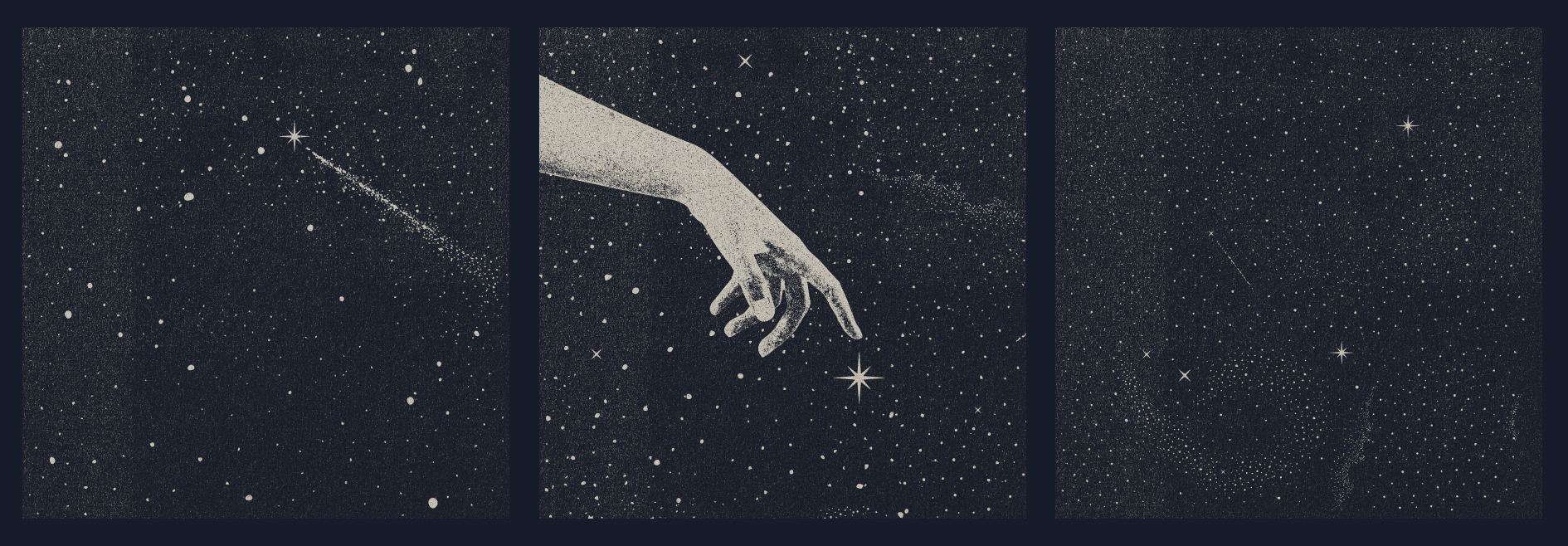
A few months later, on a midnight walk with my dog under a country sky on fire with stars, I looked up and understood what I needed to do.
Vox clamantis in tenebris
Many people I know are reaching point break.
They feel depleted, demoralized, and drifting. They have an acute sense we have lost touch with something vital, even if they struggle to articulate it. In a world flooded with content, they are starved for beauty and meaning. They feel a visceral longing for the physical, the real.
I founded Dogstar Press to offer a refuge and a remedy: a literary press uniquely devoted to beauty, sincerity, and 100% human fiction. Stories that dare to be beautiful, unguarded, and true. We are holding a lantern for writers and readers who believe in—and are searching for—authentic and artful fiction that never yields to external pressures. Our tagline, “a signal in the dark,” was inspired by Vox Clamantis In Deserto—a voice crying in the wilderness—the motto of my alma mater Dartmouth, a place where, once upon a time, I was able to think and write freely.
We are warding off artifice, ideology, and any distortion that erodes human literary art. The purpose: to offer light in a dark world with novels that have created the most enduring art in history—beauty, morality, hope, curiosity, redemption, the hero’s journey, respect for life and the human spirit, the quest for truth and meaning, and the power of transcendence.
Every decision we make stems from a single conviction: literature is not content, performance, or propaganda, it is the expression of the human soul and it must be protected.
We are reflecting this in Dogstar’s book design: a striking, timeless, collectible series of premium paperbacks and special edition hardcovers. By publishing new fiction with the reverence most publishers reserve for classics, we are honoring books as artifacts (from arte factum in Latin, meaning “made by human skill or art”) and artistic objects that endure.
As AI-written and AI-assisted novels slip into the publishing system without disclosure, Dogstar is defending the human voice with a legally binding verification process. In this age of AI, our 100% Human seal is a mark of authenticity for readers who believe literature can only be conceived and crafted by real people. Clearly signposting books that are human-made—without AI interference—is the only way we can stop the overwriting of the human voice. It’s the only way we can preserve literature as the expression of the human soul. An irreplaceable record of humanity and an eternal conversation of what it means to be alive.
The hyper-digital, hyper-political life that has been forced upon us is a dangerous condition—antithetical to our natural, God-given human condition. It is draining the life force in us, more and more by the day.
You can feel it, can’t you? How badly off track we are.
We do not need to live this way—we are meant for so much more.
We can resist this state of “hysterical nowness” as musical legend Wynton Marsalis described, disconnected from the depth and truth and wonder of human life. He said:
“When our fine art has floated away in a cloud of over-refinement that drains it of vitality...in this sweltering mass of social and cultural underachievement, we look to the success of our technological industries to define us...
Say something to me.
Touch me.
Make me feel something.
Make me understand that you know something about what it means to be alive...The science is there to serve humanity, not to be it. And the only thing ever worth remembering is what a thing means.”
As human beings we are part of an ancient lineage. We are wired to seek meaning. To let beauty render us awe-struck. To look for silver pinpricks in a pitch-black sky to guide us. To be part of the fabric of deep time.
As the algorithms thrum away, silent and ruthless, driving us farther apart, from each other and from our true purpose and potential, Dogstar Press is pursuing another way of life. Our first title will publish in September 2026, with our call for author submissions opening by this spring. We hope to be part of a growing constellation of artistic ventures shining a light, lifting up, and taking a stand for the human soul.
I sincerely hope you will draw near.
Kimberley Tait
Founder, Dogstar Press
New Hampshire, USA